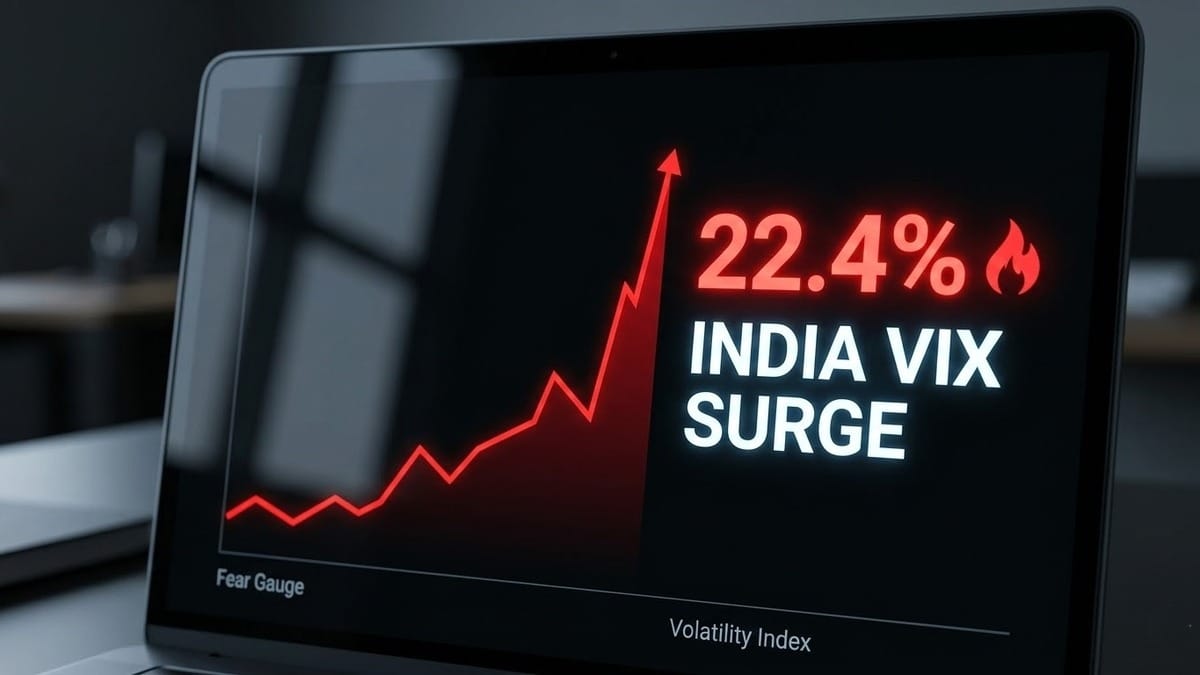
The Indian stock market’s “Fear Gauge” has officially entered the danger zone. As geopolitical tensions in West Asia triggered a massive ₹19 lakh crore wealth wipeout last week, the India VIX (Volatility Index) surged by a staggering 22.4%.
For retail investors, this spike isn’t just a number—it is a signal of extreme uncertainty that has historically preceded some of the market’s most volatile swings.
With the index now hovering above the crucial 20-level, the question on every D-Street trader’s mind is: is this the peak of fear, or just the beginning of a deeper correction?
Why the “Fear Gauge” is Spiking
The India VIX measures the market’s expectation of volatility over the next 30 days. When the VIX rises, the Nifty 50 almost always falls. This week’s 22% jump was fueled by three primary macro-economic triggers:
- Geopolitical Shocks: The escalating conflict in West Asia has forced global funds into a “risk-off” mode, leading to heavy selling in emerging markets like India.
- The $100 Oil Threat: With Brent crude nearing the $100 mark, inflation fears are back in the driver’s seat, threatening corporate margins across the board.
- Currency Crises: The Indian Rupee’s fall to a record low of 92.35 against the US Dollar has accelerated FII outflows, adding further fuel to the volatility fire.
Also Read ₹92.35: The Moment the Indian Rupee Hit a Historic Low
What a VIX Above 20 Means for Your Portfolio
Historically, an India VIX below 15 indicates a “complacent” or stable market. However, crossing the 20-level changes the game entirely:
- Option Premiums Spike: High volatility makes buying options significantly more expensive, often trapping retail “buyers” in rapid time-decay.
- Stop-Loss Hunting: In a high-VIX environment, intraday swings become wider, often hitting stop-loss levels before the market resumes its original trend.
- The “Bottoming” Signal: Paradoxically, market veterans often say “When the VIX is high, it’s time to buy.” A massive spike in fear often marks a temporary “market bottom” where long-term value emerges.
Market Impact: Nifty and Sensex
The India VIX surge has translated into real pain for equity holders, with benchmark indices posting their worst weekly performance since mid-2025.
On March 4 alone, the Sensex plunged 1,123 points (1.39%) to close at 79,116, while the Nifty 50 shed 387 points (1.56%) to 24,478—well below the psychological 25,000 mark. Broader markets fared worse, with midcaps and smallcaps down over 2%, as 2,581 stocks declined against just 675 advancers.
Also Read ₹19 Lakh Crore Vanished: Inside Nifty’s “Worst Week in a Year”
Sector-Wise Impact:
1. Oil-Sensitive Sectors: Autos and metals bore the brunt, with shares in Tata Steel and Maruti Suzuki tumbling 3-4% amid fears of cost escalations.
2. Banking Blues: The Bank Nifty index cratered 1.81% to 58,760, reflecting worries over loan growth in a high-rate environment exacerbated by global inflation risks.
3. IT Resilience: Tech stocks held relatively flat, buoyed by US client spending, but even here, volatility edged higher.